
From public spaces and large-scale gatherings to critical infrastructure, drone threats have become a global security challenge. With the proliferation of drone technology and increasing risks of misuse, the anti-drone market is undergoing unprecedented rapid growth and technological innovation. This article provides an in-depth analysis of the current state of the anti-drone market in 2025, key technologies, industry challenges, and future development trends.
Overview of the Anti-Drone Market in 2025
Unauthorized drone security threats have become a major concern for government agencies and authorized organizations. Whether preventing inappropriate surveillance during public events or responding to terrorist threats, anti-drone technology has become an urgent necessity of our time.
With major defense companies and private enterprises competing in the anti-drone market, related technologies are rapidly evolving and advancing.
What is Anti-Drone Technology?
Anti-drone technology, also known as counter-UAV technology, encompasses a range of devices capable of detecting, tracking, and neutralizing unauthorized or malicious drones in designated airspace. Typical anti-drone systems include active radars or RF detectors, drone jammers, and tracking cameras.
These systems not only detect unauthorized drones but also track their flight patterns to identify suspicious activities and take countermeasures when necessary.
Market Growth and Key Statistics
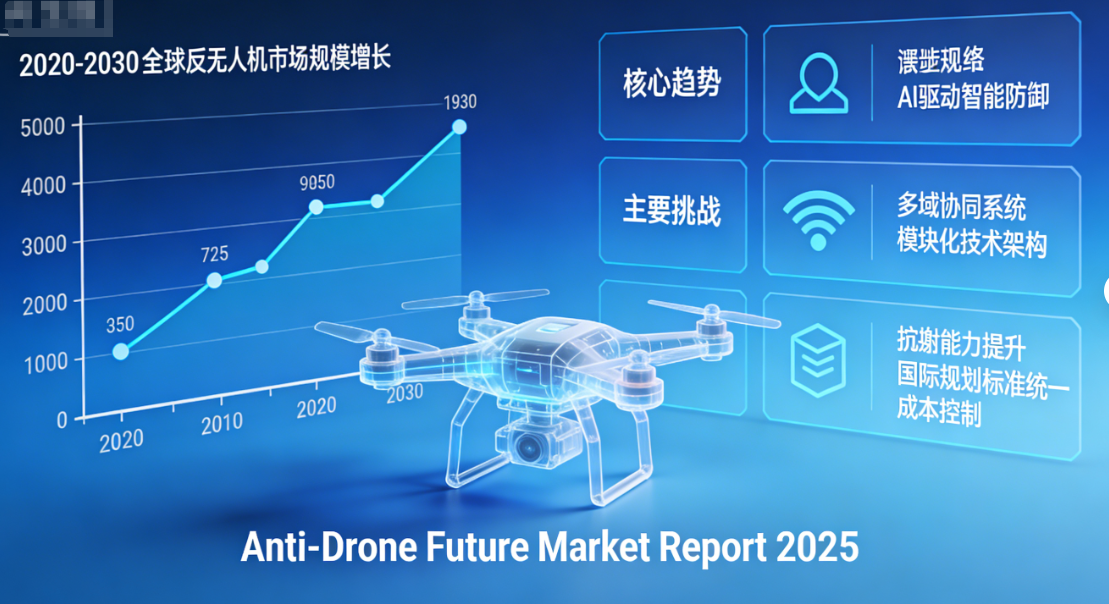
In 2024, the global anti-drone market value reached $2.4468 billion, showing significant growth from $576.7 million in 2018. It is projected that the anti-drone market revenue will reach $10.58 billion by 2030.
Of the 2024 revenue, the United States contributed $919.2 million, expected to grow by 22.5% to $3.216 billion by 2030. Among European countries, the United Kingdom was the largest contributor with $180.2 million in revenue in 2024, followed closely by Germany with $150.7 million in revenue and a CAGR of 29.5%.
The Asia-Pacific region is the third-largest market for anti-drone devices, with revenue of $470.8 million in 2024. This region is expected to have the highest CAGR of 30.6% from 2025 to 2030.
Challenges Facing the Anti-Drone Industry
Although the anti-drone industry has promising development prospects, it still faces numerous challenges:
Evolving Drone Technology and Escalating Threats
Drone technology is rapidly advancing to counter existing anti-drone devices. For example, traditional radars may fail to detect small or micro-lightweight drones; cameras may be ineffective in low-visibility conditions; and acoustic sensors may have limited accuracy in noisy environments.
Therefore, innovative technologies such as active radars, RF detectors, and thermal imaging cameras are crucial for addressing the latest drone technologies.
Legal and Regulatory Frameworks
Although the largest market for anti-drone devices is in critical infrastructure, most operations are conducted by government departments. Regulations for anti-drone technology vary by country and must comply with the legal norms of the country where they are sold.
High Costs and Implementation Barriers
The R&D costs for new anti-drone technologies are high. While demand for anti-drone technology continues to grow, high-tech companies still require substantial R&D investments, which keeps the prices of anti-drone systems elevated.
Key Trends Shaping the Anti-Drone Market
The anti-drone market is experiencing rapid growth, primarily driven by the following factors:
Advances in Artificial Intelligence and Machine Learning for Drone Detection
Artificial intelligence and machine learning not only enable rapid responses to unauthorized drones but also track and record flight patterns and other drone data. Consequently, AI- and ML-based anti-drone technologies are paving the way for all emerging innovations.
Rise of Directed Energy Devices, Spoofing, and Jamming Systems
Technologies using lasers to neutralize unauthorized drones are classified as directed energy devices. While effective, these devices are less commonly deployed as they often damage the drones. In contrast, RF jammers and GPS spoofing devices offer better solutions, forcing drones to land, return, or be redirected.
Development of Commercial Anti-Drone Solutions
The development of commercial solutions has progressed in tandem with the growth of drone usage. Protecting public spaces and critical infrastructure is a top priority, leading governments and authorized organizations to seek the latest anti-drone technologies for deployment in their jurisdictions.
Regional Market Insights
The global anti-drone market is projected to reach $2.97 billion in 2025, growing to $26.26 billion by 2034, with an estimated CAGR of 27.52% from 2025 to 2034.
At the regional level, the United States is the largest market, accounting for 42% of the total anti-drone industry revenue in 2024. The Asia-Pacific anti-drone market is expected to grow by 29.2% by 2029, driven primarily by contributions from countries such as South Korea, India, Japan, Australia, and Singapore.
According to relevant research, the European anti-drone market generated $737 million in revenue in 2024 and is poised for a CAGR of 28.2%. Among specific countries, the United Kingdom and Germany lead the way, followed by Italy, France, and Spain.
The Middle East and Africa represent an emerging market for anti-drone technology, with projected revenue of $584.2 million by 2030 and a CAGR of 30.2% from 2025 to 2030.
Key Technologies and Products in 2025
From portable devices to fixed and vehicle-mounted defense systems, the following are some of the latest anti-drone technologies and devices:
Detection and Identification Technologies
To accurately detect, identify, and track unauthorized drones in designated airspace, anti-drone systems typically employ active radars, RF detectors, optical sensors (long-range, visible-light, and thermal imaging cameras), and acoustic sensors. Among these, active radars and RF detectors are the most reliable and accurate drone detection devices.
Countermeasures and Advances
Using detection technologies as the first step, anti-drone systems can implement the following countermeasures upon detecting unauthorized drones:
- RF jamming to suppress control signals and force drones to land or return
- Spoofing drone navigation systems to redirect them to preset locations
- Using directed energy devices to disable drones
- Kinetic interception using nets
Additionally, AI- and automation-driven anti-drone technologies can reduce response times to drone threats, enhancing operational efficiency and generating real-time analytics to better address future drone threats.
Future Outlook for Anti-Drone Solutions
Technological advancements such as artificial intelligence, machine learning, advanced radars, and RF detectors are enabling rapid improvements in anti-drone systems, thereby driving market projections. Furthermore, a focus on solutions that disable drones rather than destroy them has accelerated the development of devices that spoof or jam drone signals.
Collaborations between private defense service providers and government agencies have also facilitated the R&D process for anti-drone solutions. Clear regulatory frameworks are expected to create a more favorable environment for high-tech companies engaged in anti-drone technology.
Conclusion
The rapid development of technology, coupled with growing demand for anti-drone solutions, has jointly driven market expansion. The Asia-Pacific and Middle East regions are among the fastest-growing markets for anti-drone technology, with projected growth rates exceeding 30%.
With the emergence of innovative products such as active radars, RF detectors, RF jammers, and thermal imaging cameras, anti-drone devices are continuously evolving to address each new drone challenge.