
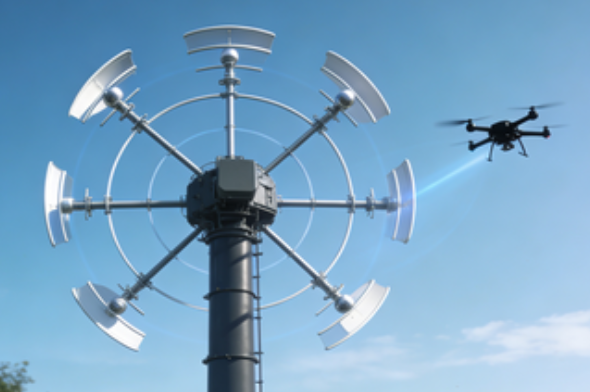
In the realm of low-altitude airspace security, radar has emerged as a critical technological tool to counter drone threats, with its integration into comprehensive counter-drone and drone jamming systems being paramount. When targeting drones characterized by an extremely small radar cross-section (RCS), low flight altitude, and slow speed, traditional radar systems often prove inadequate. This necessitates that dedicated anti-drone radars possess the dual capability of detecting minute targets and suppressing complex background interference. Selecting an effective radar solution for a counter-drone system requires comprehensive evaluation across several core technical dimensions.
Firstly, complex ground clutter presents a primary source of interference. Advanced signal processing technologies form the foundation for effectively filtering this noise and isolating genuine drone signals—a crucial first step before any drone jamming or neutralization action can be taken. Secondly, the spatial coverage capability of the system is vital. The horizontal azimuth determines the surveillance scope, while the vertical elevation angle impacts the completeness of low-to-mid altitude detection; an excessively narrow elevation angle can create significant blind spots. 3D radar technology, by providing target altitude information, not only enhances positioning accuracy but also serves as an effective tool for distinguishing true threats from ground clutter in complex terrain.
In terms of technical architecture, systems are primarily divided into active and passive categories. Active radar detects by emitting radio waves; within this category, pulse-based systems excel at long-range distance measurement, while continuous wave systems offer greater sensitivity in measuring the velocity of slow-moving targets. Passive radar, which operates without emitting signals by instead utilizing ambient radio waves for detection, offers and is suitable for sensitive areas requiring electromagnetic silence—a feature often valued in covert counter-drone operations. Furthermore, the radar's operating frequency band (e.g., X-band, K-band) directly influences the system's detection resolution and physical size. Radars employing different operational modes, such as stare (for focused tracking) or rotation (for wider coverage), present trade-offs between detection performance and surveillance range.
In conclusion, building a reliable low-altitude drone surveillance network, which serves as the essential "eyes" for any subsequent drone jamming or mitigation strategy, requires finding the optimal balance between clutter suppression, airspace coverage, technical architecture, and deployment mode, based on the specific protection scenario, performance requirements, and environmental conditions. A well-designed anti-drone radar system forms the solid technological cornerstone for ensuring the security of critical airspace within an integrated counter-drone framework.